Arm Holdings delivered record fourth-quarter results and projected first-quarter revenue above Wall Street expectations on Wednesday, fueled by surging demand for its chip technology in AI data centers. But the celebration was short-lived — executives revealed on the earnings call that they have not secured enough supply to meet a second wave of demand for the company’s new AGI CPU, sending shares sharply lower on Thursday.
Earnings Beat, Then Reversal
Arm reported fiscal Q4 2026 revenue of $1.49 billion, a 20% year-over-year increase that topped analysts’ estimates of $1.47 billion. Adjusted earnings per share came in at 60 cents, beating the 58-cent consensus. For the current quarter, the company guided revenue to $1.26 billion and adjusted EPS of 40 cents, both above Street expectations of $1.25 billion and 36 cents, respectively.
Shares initially surged 12% in after-hours trading following the report but reversed sharply after CEO Rene Haas told analysts on the conference call that Arm has not yet locked in the manufacturing capacity needed to fulfill the next tranche of orders for its AGI CPU. The stock fell more than 8% in Thursday’s regular session.
The Supply Wall
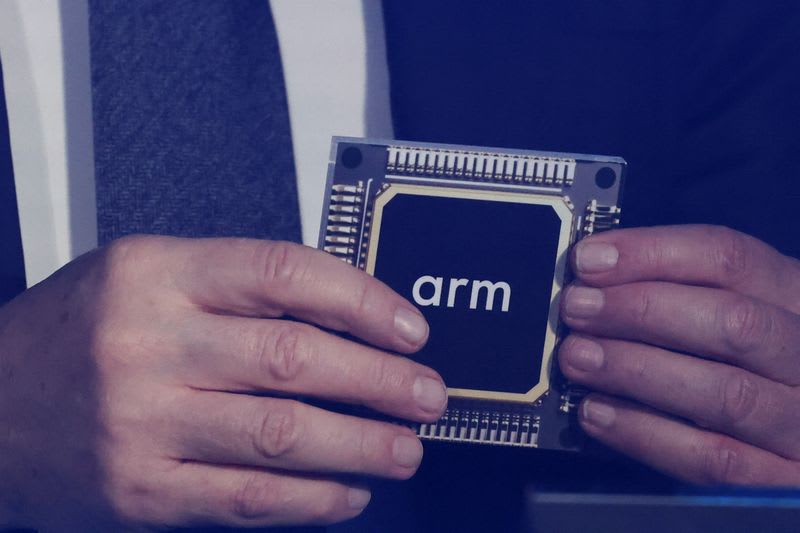
The AGI CPU, unveiled at the company’s “Arm Everywhere” event in late March, represents Arm’s first foray into designing and selling its own chips rather than simply licensing its architecture. Customer demand has now topped $2 billion across fiscal years 2027 and 2028 — more than double the figure disclosed at the chip’s launch. However, Arm has secured enough capacity to meet only about half of that demand, according to executives on the call.
“We are very bullish about this data center demand,” Haas said, noting the current quarter includes a “pretty healthy uptick in terms of royalties associated with the data center”. Still, analysts pressed on the costs of entering chip manufacturing and the timeline for resolving supply constraints. Revenue from the first production silicon is not expected until the fourth quarter of fiscal 2027, with large-scale production slated for fiscal 2028.
Data Centers Poised to Become Largest Segment
In their shareholder letter, executives wrote that data centers are “on course” to become Arm’s largest business segment, with datacenter royalty revenue more than doubling year-over-year. The company said it remains on track to hit its $15 billion long-term revenue target.
Bloomberg reported that Haas acknowledged smartphone unit growth “flipped to negative” last quarter, though the weakness was concentrated in the lower end of the market. The contrast underscores Arm’s rapid pivot: once defined by mobile, it now derives its growth narrative almost entirely from AI infrastructure, where its architecture powers roughly half of hyperscale server deployments.
The central tension is now clear — demand for Arm’s new chips far outstrips its ability to supply them, and investors must weigh a transformed growth story against near-term execution risk.