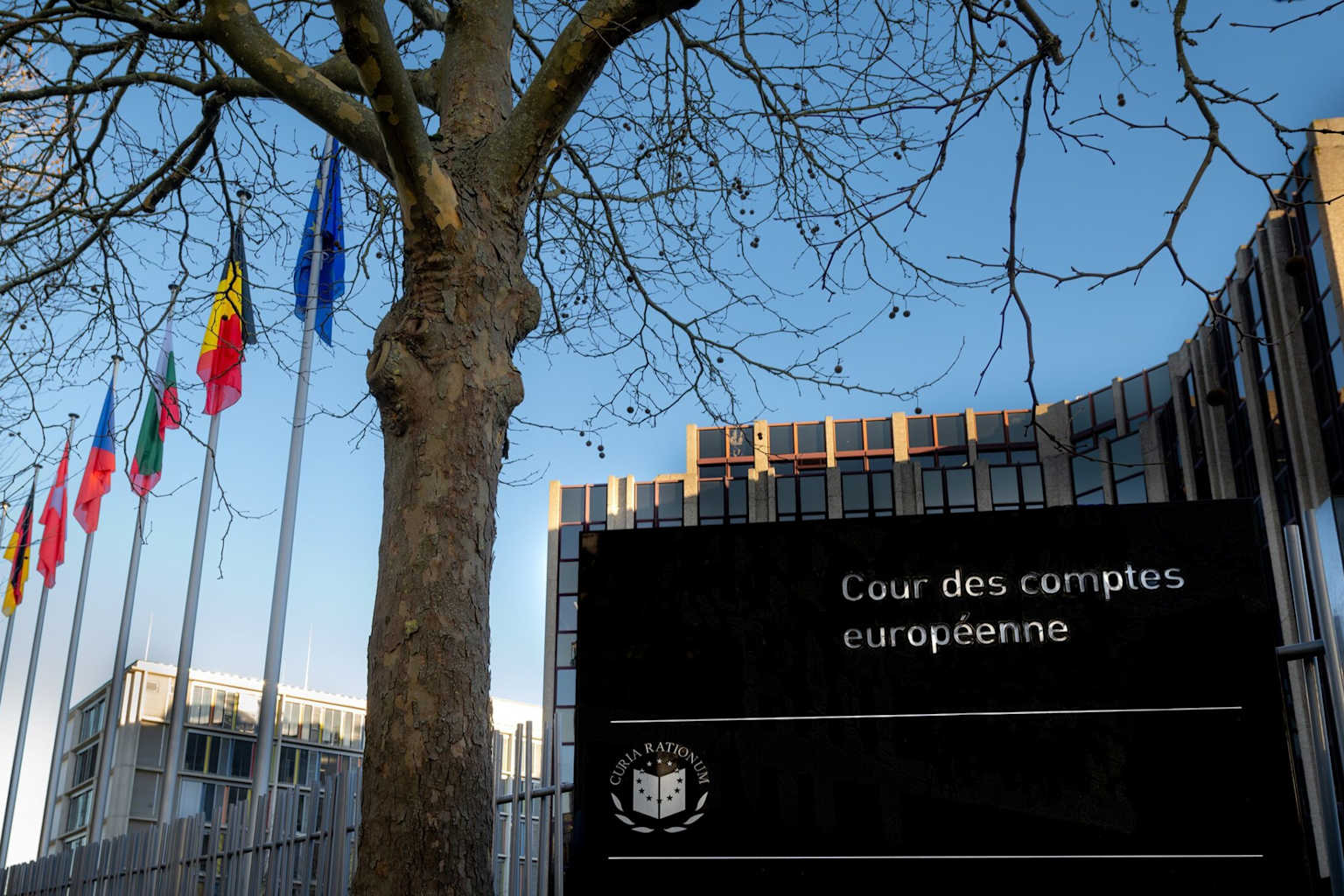
The European Court of Auditors said Wednesday that billions of euros from the EU’s pandemic recovery fund cannot be clearly traced to their final recipients, raising questions about accountability as the bloc considers replicating the model in its next long-term budget.
In a special report published on May 6, the ECA found that the €577 billion Recovery and Resilience Facility — established in 2021 to help member states rebuild after COVID-19 — suffers from a “huge lack of transparency,” in the words of Ivana Maletić, the court member who led the audit.
Thousands of Recipients Unidentified
The auditors examined 10 EU countries and found that the top 100 listed beneficiaries were almost exclusively public bodies — ministries, municipalities, and state-owned enterprises such as railways — accounting for more than half of listed recipients and around 80 percent of reported amounts. Those public bodies then distribute funds onward to thousands of private companies, NGOs, banks, and investment funds that remain largely invisible to oversight.
“Without this information, we cannot assess whether funds are fairly distributed, whether risks of concentration exist, whether EU money delivers value for citizens,” Maletić said.
Member states are only required to publish their 100 largest recipients, a rule introduced two years after the facility launched. Some countries, including Austria, Estonia, France, and Spain, have built dashboards showing funded projects, but even these lack detail on final beneficiaries or investment results.
Commission Rejects Recommendations
The European Commission, in a written response shared with EUobserver, said it “could not endorse” the auditors’ recommendations. Commission spokesperson Maciej Berestecki said Brussels had “issued guidance” and held “dedicated meetings” with member states but added that “there is no legal basis for the Commission to request or analyse such national data” on actual costs.
The standoff reflects a structural tension: unlike traditional EU programmes that reimburse documented expenses, the RRF disburses money when governments hit agreed milestones and targets — not when they prove how funds were spent downstream. The facility was designed rapidly during the bloc’s deepest recession, prioritizing speed over granular cost tracking.
Stakes for the Future Budget
The findings carry weight beyond the current fund. The Commission has signaled its intention to use the RRF’s performance-based model as a template for the EU’s next seven-year budget. The auditors’ report amounts to a warning that scaling up the approach without addressing transparency shortfalls could entrench the same blind spots across a far larger pool of spending.
“We need information on all the recipients. Not only we, but citizens, journalists, everybody who would like to see how money is spent,” Maletić said.